King’s Cross Life-Sciences Forward Funding: Why Camden Schemes Clear Yields Sharper Than BTR in 2026
The most striking number on any London borough term sheet in 2026 is not on a Mayfair refurb or a Walthamstow town-centre scheme. It sits in postcode N1C, on the King’s Cross life-sciences pipeline. Institutional forward-fund commitments on credible life-sciences product cleared 5.0 to 5.5 per cent net yields through 2025 and into Q2 2026. That is sharper than BTR. Sharper than PBSA. Sharper than office. And it is the structural reason Camden sits at -6.4 per cent on the headline borough number while the financed-GDV picture across the borough is materially better than the resi-comparable picture suggests.
This piece walks the King’s Cross life-sciences underwriting model — what makes the floor plate hard to substitute, why Cambridge cluster spillover plus the Crick anchor matters, and how the same regen-zone pricing band is now being applied to commercial-to-residential conversion in Bloomsbury and the Holborn fringe. Then it sets that against the Hampstead super-prime townhouse drag that pulls the headline number down, and shows how the lender pool is pricing two materially different bands inside one borough name.
Why Camden is the most diversified borough capital stack in 2026
Camden is the only borough in inner London where four separate institutional capital flows meet in one administrative footprint. Life sciences forward-funding into the King’s Cross Knowledge Quarter. Commercial-to-residential conversion in Bloomsbury and the Holborn fringe. Mid-rise resi-led origination through Camden Town and Kentish Town. And value-add reposition on the prime townhouse stock through Hampstead, Belsize Park and Primrose Hill. The lender pool prices each of those four flows on a different model with a different take-out and a different equity threshold.
The result is that Camden carries a wider capital-stack range in 2026 than any other London borough. King’s Cross life-sciences forward-fund yields at 5.0% to 5.5% net are the sharpest yields institutional capital is taking on any London product class in 2026, sharper than BTR. Hampstead and Belsize Park senior debt pricing on prime townhouse repositioning sits in the correction-zone band at 6.75% to 7.25% per annum, 65% LTGDV. The same borough name covers both, and the underwriting models do not touch.
That diversification is the structural reason the borough has not stalled. Westminster has a regen-zone band that mitigates its prime-central correction. Camden has an institutional growth zone that does not just mitigate but actively dominates the financed-GDV picture. King’s Cross alone accounts for a meaningful share of all inner-London commercial-and-mixed-use forward-fund commitments in 2026.
Reading the -6.4% in context
Camden’s -6.4% is best read against three reference points.
Against Westminster at -10.8% and Kensington and Chelsea at -11.2%, Camden is materially shallower. Both Westminster and K&C are dominated by international super-prime exposure that has not seen a sustained recovery in any of the conditions that drove the prior cycle. Camden carries some of the same exposure in Hampstead and Belsize Park, but Bloomsbury and Fitzrovia north hold up better than the Mayfair and Belgravia stock because the demand mix is closer to domestic prime than international super-prime. The university and museum anchor in Bloomsbury supports a deeper end-user pool than the equivalent prime central pair gets at the £4m to £12m end.
Against Hackney at -2.5%, Camden is materially deeper. Hackney’s 2015 to 2022 boom ran harder, but Hackney did not have a Hampstead-equivalent super-prime drag pulling the borough average down. The Camden-Hackney spread of 3.9 percentage points is essentially the Hampstead-and-Belsize-Park drag showing up in the borough average.
Against Walthamstow at +5.9%, Camden is 12.3 percentage points behind. That spread is the cleanest illustration in the table of what the trajectory pricing model is actually doing in 2026. Walthamstow had less to give back from the prior cycle and sits on a clean Victoria Line and Overground catchment with shallow institutional concentration. Camden has more to give back, but the King’s Cross financed pipeline is a feature Walthamstow does not have.
So Camden is mid-table, but the borough number is doing real work to compress two opposite forces into a single line. Underwrite Camden as one number and you will misprice the site by a wider margin than in any other inner London borough.
The sub-zone anatomy
King’s Cross and St Pancras (N1C and the WC1H/WC1X frontage). The structural growth zone of inner London. Life sciences anchor with the Knowledge Quarter, the Crick and the UCL biomedical cluster. Google’s HQ campus. Mixed-use commercial-led with residential and PBSA in supporting roles. Lender pricing here sits in the regen-zone band, closer to the outer-London growth pricing than to anything in inner west. Forward-fund commitments from European and US institutional capital have been the dominant source of pre-completion equity into the corridor across 2025 and into 2026. Net yields on credible life-sciences product clear at 5.0% to 5.5%, materially sharper than BTR forward-fund yields at 5.25% to 5.75% on the same corridor.
Bloomsbury (WC1B, WC1E, WC1H, WC1N). Premium domestic prime. University and museum anchor. UCL, the British Museum, SOAS, Birkbeck, the British Library to the north and the Foundling-and-Coram conservation belt to the south. Family-resi market in the Bedford Estate sense, plus a meaningful commercial-to-residential conversion pipeline running through the Holborn fringe and the Bloomsbury squares. The most resilient prime sub-zone in inner London, holding meaningfully better than Mayfair, Belgravia, Knightsbridge or Chelsea on a like-for-like basis. The end-user demand depth from international students, academic and museum-sector buyers, and Bloomsbury-specific domestic prime gives this sub-zone a structurally deeper bid than the prime central pair gets.
Holborn (north WC1V) and Fitzrovia (north W1T). Commercial-led mixed use, with active commercial-to-residential conversion as primary deal flow. Lender pricing here tracks the Bloomsbury and King’s Cross regen-zone band rather than the prime-central correction band, because the take-out on a converted commercial-to-resi product is institutional-feeling: a thin-bid HNW domestic prime buyer pool plus an executive rented residential exit.
Camden Town and Kentish Town (NW1 and NW5). Mid-tier resi-led market, the spine of the borough. Camden Town carries the music, market and creative anchor that has supported demand depth through the cycle. Kentish Town is family-resi in the converted Victorian terrace sense. Closer to flat year on year than the borough average suggests. Mid-rise resi-led origination here is the most consistently financeable open-market resi product in the borough, structured through senior development finance at 6.5% to 7.0% per annum and 65% to 70% LTGDV.
Hampstead and Belsize Park (NW3). The premium suburban belt. Townhouse stock, conservation areas, Hampstead Heath frontage. The hardest part of the borough in 2026. Super-prime townhouse stock is correcting harder than the headline -6.4% because the demand pool at the £8m to £20m townhouse end is thin, similar in character to the Belgravia and Mayfair drag. The largest concentration of value-add reposition deal flow in Camden is here. Bridging-led, short construction window, exit to a HNW end-user pool that has not recovered to 2018-2021 depth.
Primrose Hill (NW1, the western frontage). Premium townhouse, deep family-prime concentration, anchor amenity in the park. Tighter than Hampstead on the -6.4% comparison because the absolute supply of available stock is smaller and the demand depth is more domestic. Value-add reposition is the dominant product.
West Hampstead (NW6). Family-resi plus transport hub. Thameslink, Overground and Jubilee interchange anchor. Closer to the Camden Town / Kentish Town band than to the Hampstead super-prime band. Mid-rise resi-led with a Thameslink-anchored absorption story.
What lenders are pricing on Camden schemes in 2026
Camden is the only inner-London borough where the same lender pool is actively pricing on two materially different bands inside the same borough name. The correction-zone band applies to Hampstead, Belsize Park, Primrose Hill, and the prime end of Camden Town. The regen-zone band applies to King’s Cross, Bloomsbury, Holborn north, Fitzrovia north and the commercial-to-resi conversion pipeline.
Senior development finance on a Hampstead or Belsize Park value-add reposition is pricing 6.75% to 7.25% per annum at 65% LTGDV. That is the correction-zone band, 25 to 50 basis points wider than equivalent connected outer pricing, with leverage capped 5 percentage points lower. Stretched senior products are available with strong cost certainty at 7.5% per annum and 75% LTGDV. The same lender pool, on a King’s Cross commercial-to-residential conversion or a Bloomsbury Holborn-fringe scheme, is pricing senior at 6.5% per annum and 65% to 70% LTGDV. The 25 to 75 basis point spread inside the same borough is unusual.
Mezzanine finance appetite is thinner on the Hampstead and Belsize Park super-prime end than on the Camden Town and Kentish Town mid-tier. Where mezz prices on a prime Camden scheme it sits at 12% to 13% per annum with a smaller pool than Camden Town gets at 12% per annum. JV equity providers are demanding 22% to 25% IRR targets on the prime end versus 18% to 22% on the mid-tier and regen-zone product.
The structurally active layer in Camden is forward funding. Life-sciences forward funding at 5.0% to 5.5% net yield is the dominant capital flow into King’s Cross. BTR forward funding on the King’s Cross and Camden Town mixed-use schemes clears at 5.25% to 5.75% net yield. Both yields are sharper than what the same institutional pools will commit to in any of the outer growth boroughs, because the King’s Cross corridor specifically has institutional appetite that other corridors do not match.
Bridging is active across the borough, particularly on Hampstead townhouse reposition and Camden Town value-add windows. Pricing 0.55% to 0.75% per month, with the wider end on the Hampstead super-prime exit where the buyer pool is thinner.
The King’s Cross life-sciences multiplier
The King’s Cross story in 2026 is the structural reason Camden’s headline correction does not translate into a financed-GDV correction. Life sciences as a sector requires very specific real estate. Wet-lab compatible floor plates, vibration tolerances, ventilation and gas service densities that conventional commercial product does not deliver. The King’s Cross Knowledge Quarter has the largest concentration of consented and under-construction life-sciences floor plate of any UK city, anchored by the Crick, UCL biomedical, the Wellcome and the spillover demand from the AstraZeneca Cambridge cluster.
Institutional forward-fund commitments into King’s Cross life-sciences product cleared 5.0% to 5.5% net yields through 2025 and into 2026. That is sharper than BTR. Sharper than PBSA. Sharper than office. The yield reflects two things. First, the supply pipeline is genuinely constrained even relative to demand, which keeps tone firm. Second, the operational counterparty risk is institutional research and academic, which institutional capital prices at a lower discount than retail or speculative office.
The implication for site acquisition in the King’s Cross corridor is that the underwriting model is not residential at all. It is a yield calculation on a forward-fund commitment, and the comparable set is more Cambridge North than it is Bloomsbury. The land basis the appraisal supports is materially higher than what a resi-led appraisal would clear on the same site, which is what has kept the King’s Cross pipeline moving while the prime central pair has stalled.
Why Bloomsbury is the most resilient prime sub-zone in inner London
Bloomsbury holds up because the demand mix is structurally different from the international super-prime postcodes. The Bloomsbury buyer pool at the £2m to £8m flat-and-house end is dominated by domestic prime, professional household formations, university-and-museum-sector buyers, plus a tail of international academic and student-family buyers anchored by UCL, SOAS, Birkbeck and the British Library cluster. None of those buyer pools have evaporated the way the Mayfair-and-Belgravia ultra-HNW pool has thinned.
The product mix is also different. Bloomsbury runs heavily to converted Bedford Estate stock, conservation-area townhouse and mansion-block flats, and a meaningful pipeline of commercial-to-residential conversion through the Holborn-and-Bloomsbury Square frontage. The conversion product takes an institutional-feeling exit through executive rented residential or domestic prime sale at the £1,200 to £1,600 per square foot band, which is the sharp end of where Bloomsbury comparables sit but well above the borough median.
The pricing impact is direct. Bloomsbury senior debt is being priced 25 to 50 basis points tighter than Hampstead-and-Belsize-Park senior debt on equivalent leverage, despite both sitting inside Camden. That 25 to 50 basis point inside-borough spread is the operative input on any Camden site appraisal in 2026.
What is actually transacting in Camden
Four categories of activity dominate Camden deal flow in 2026.
1. King’s Cross life-sciences forward funding (the dominant category by GDV). Mixed-use schemes on the King’s Cross and St Pancras frontage built for institutional take-out as life-sciences floor plate, with residential and PBSA in supporting roles. Forward-fund commitments at 5.0% to 5.5% net yield, regen-zone senior at 6.5% per annum on the construction layer, equity threshold materially lower than the open-market resi alternative.
2. Bloomsbury and Holborn commercial-to-residential conversion. Existing commercial product on the Bloomsbury Squares, Holborn frontage and Fitzrovia north repurposed to residential on the back of post-NPPF reform planning routes. The take-out is split between domestic prime sale at £1,200 to £1,600 per square foot and an institutional executive rented residential exit. Capital stack runs senior at 6.5% per annum and 65% to 70% LTGDV with a meaningfully shorter equity stack than ground-up new-build.
3. Camden Town and Kentish Town mid-rise resi-led. The spine of the borough. 4 to 10 storeys, 60 to 250 homes, brownfield, around the Camden Town tube node, the Kentish Town spine and the Camden Lock corridor. The most consistently financeable open-market resi product in the borough at 6.5% to 7.0% per annum senior debt, 65% to 70% LTGDV, 12% per annum mezzanine layered to 90% of cost.
4. Hampstead value-add reposition on townhouse stock. Bridging-led, short construction window of 9 to 14 months, exit to a HNW end-user. The largest concentration of bridging deal flow in Camden by value. Thinner exit demand than 2018-2021, which is widening the exit-buyer-pool risk premium that lenders price.
What is much smaller in 2026: ground-up new-build resi-led origination on rare consented Hampstead, Belsize Park or Primrose Hill sites. That deal flow is real but small, with similar equity thresholds (35%-plus of cost) and sponsor-track-record gating to the Mayfair and Belgravia equivalent.
How the capital stack works on a £30-50m GDV Camden scheme
A typical Camden Town or Kentish Town mid-rise resi-led scheme at this scale, with strong PTAL within a 10-minute walk of a Northern Line node, can be financed with senior development finance at 65% to 70% LTGDV (around 6.5% to 7.0%), mezzanine layered to 90% of cost (12% per annum), and a modest equity or JV equity component to close the gap. Total senior plus mezz cost-of-funds blends in the high sevens, with the JV equity targeting 18% to 22% IRR over the construction-and-absorption window.
On a King’s Cross life-sciences forward-funded scheme of similar scale, the structure is very different. The institutional forward-fund commitment de-risks the take-out at 5.0% to 5.5% net yield, which compresses the senior layer by 50 to 75 basis points compared with the equivalent open-market resi structure. Mezzanine is largely unnecessary on the forward-funded scheme because the equity gap closes against a contractually-committed take-out. Blended cost-of-funds on a King’s Cross forward-funded scheme can sit in the high sixes, materially tighter than the borough’s resi-led structure.
On a Hampstead or Belsize Park value-add reposition at the £30m to £50m GDV end, the structure tightens to bridging plus refurb plus equity, with a shorter construction window and an open-market HNW exit. Bridging in this band sits at 0.65% to 0.75% per month, with the equity demand 30% to 35% of cost reflecting the exit-pool risk premium.
On a larger King’s Cross mixed-use scheme (£100m to £300m GDV), the institutional senior pool re-engages, multiple life-sciences and BTR forward-fund operators compete for allocation, and the capital stack becomes more institutional than developer-led. Camden supports materially larger consents than Bromley or Croydon, with the King’s Cross corridor in particular running scheme sizes that the outer-south boroughs do not match.
What this means for site acquisition
If you are pricing a Camden site in 2026, three things matter more than they have in any recent cycle.
One. The sub-zone is the appraisal. A King’s Cross site, a Bloomsbury site, a Camden Town site and a Hampstead site are four different propositions with four different capital structures and four different take-out models. The borough average tells you almost nothing useful about any individual site. Get the sub-zone, the postcode, the take-out structure and the buyer profile on the first page of the IM.
Two. The take-out structure is the gating question. Open-market resi sale at original peak underwriting is not the answer in much of the borough in 2026. Life-sciences forward funding at 5.0% to 5.5% net yield is the answer for King’s Cross. Commercial-to-residential conversion with a domestic prime exit is the answer for Bloomsbury and Holborn. Open-market resi sale is the answer for Camden Town, Kentish Town and West Hampstead. Bridging-led value-add with a HNW end-user exit is the answer for Hampstead, Belsize Park and Primrose Hill. Anything that does not fit one of those four take-out structures is not getting senior debt at competitive terms.
Three. The construction window is now a significant variable. Short-window value-add (9 to 14 months) is the most financeable corner of the prime end of the borough. Long-window new-build (24 to 36 months) carries the most trajectory exposure on the open-market resi side, and lenders are pricing that exposure into the senior margin and the equity IRR. The King’s Cross forward-funded model is the structurally-favoured exception, because the take-out commitment removes the trajectory question entirely.
For full borough-by-borough sold price data, the King’s Cross, Bloomsbury and Hampstead sub-zone pipeline references, viability modelling and the underlying capital stack benchmarks behind this analysis, see the Greater London Property Market Report 2026. Borough-specific intelligence sits on the Camden location page, with dedicated pages for King’s Cross, Bloomsbury and Hampstead underneath.
See also: Walthamstow +5.9% on YouTube and The £650/sq ft Cliff on YouTube.
Listen to the full episode
For the dedicated deep dive on this borough, we have published a stand-alone Camden episode of the Construction Capital podcast: Camden -6.4%: King’s Cross Life Sciences, Bloomsbury Resilience and the Hampstead Drag. Around ten minutes covering the King’s Cross life-sciences multiplier, the Bloomsbury domestic prime resilience, the Hampstead and Belsize Park super-prime drag, the full April 2026 capital stack with the regen-zone and correction-zone bands inside one borough, and what is actually transacting across King’s Cross, Bloomsbury, Camden Town and Hampstead in 2026.
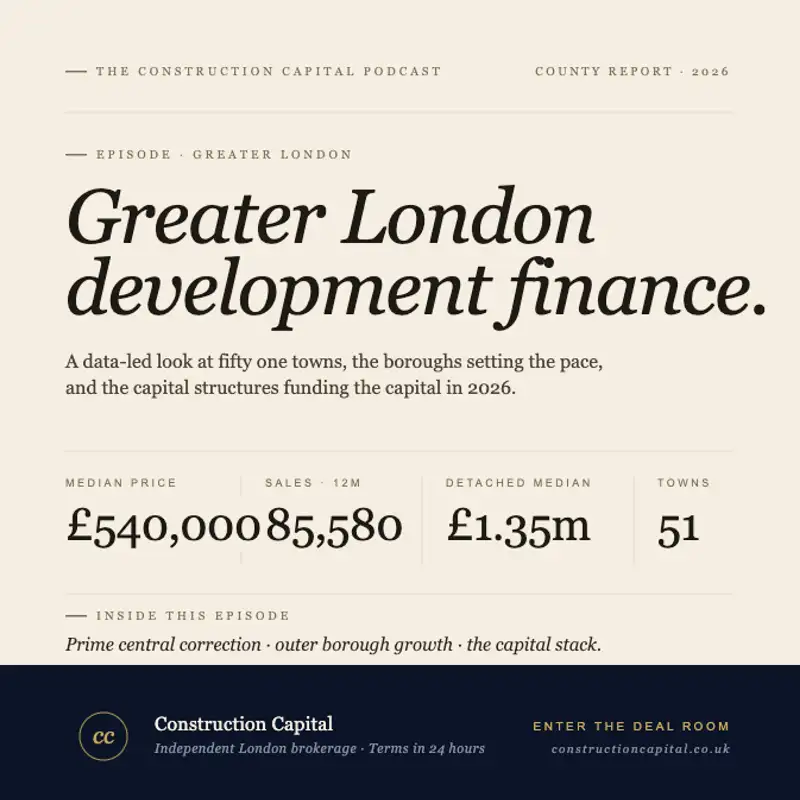
This article also draws on Episode 2 of the Construction Capital podcast: Greater London Property Development Finance 2026: Market Analysis, House Prices and Lending Outlook.
Listen anywhere
Listen on Apple Podcasts, Spotify, Overcast, Pocket Casts, or Amazon Music.
For indicative terms on a Camden scheme within 24 hours, submit through the Construction Capital deal room. Construction Capital sources terms from over 100 lenders across development finance, bridging, mezzanine and equity.
Published by Construction Capital, an independent capital advisory brokerage sourcing terms from over 100 lenders across development finance, bridging, mezzanine, and equity. This article is part of the Greater London 2026 series accompanying the Construction Capital podcast.